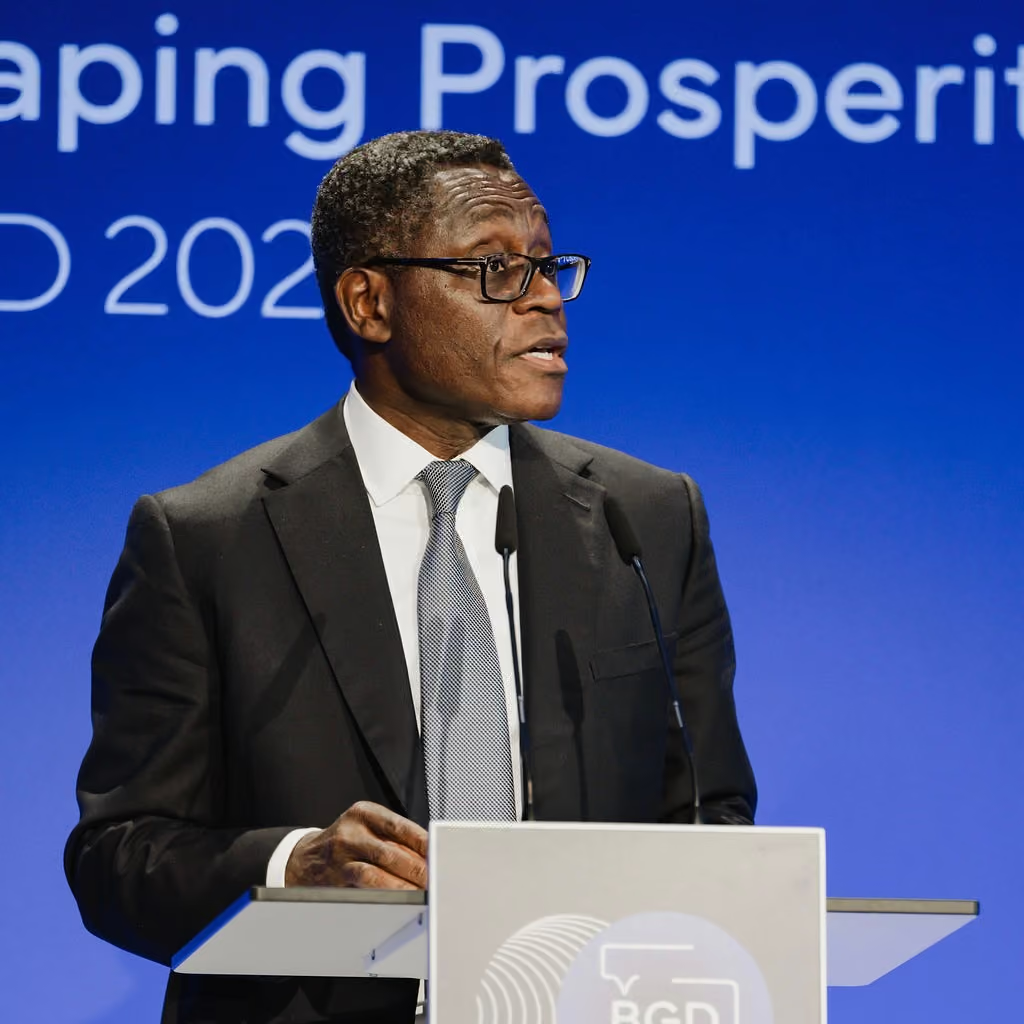
Bernard Mensah, President of International at Bank of America, shares his thoughts on the current geopolitical landscape - and how to keep capital, trade and investment flowing in times of uncertainty.
Interviewed by Klara Marie Schroeder
The biggest change is that geopolitics has become economics. Energy, technology, supply chains, critical infrastructure and access to capital are increasingly viewed through the lens of economic security. That is changing how governments set policy and how companies decide where to invest, manufacture and source.
But I don’t think globalization is over. It is being rewired. Companies still want to grow internationally, and capital still needs to move across borders. The challenge now is to build greater resilience without sacrificing the openness, competition and investment that drive growth. Economic security should not mean economic isolation.
It starts with our clients. They are thinking much more strategically about where they invest, how they secure supply chains, where they hold liquidity and how they maintain access to markets and technology. Our Global Research team has been tracking this shift for some time: supply chains are increasingly being designed not simply for maximum efficiency, but for resilience and optionality. Our job is to connect those decisions with capital.; and our global footprint gives us a particularly broad perspective. We have relationships with 78% of the Global Fortune 500 and operate across more than 35 countries. Germany is a good example: we work with around 77% of the DAX 40, and we are a Top 3 investment bank in EMEA. Meaning - we see these changes directly through the decisions some of the world’s largest companies and investors are making. That’s increasingly what clients need from a global bank: capital, connectivity and execution across markets.
I wouldn’t separate the two. Geopolitical risk increasingly becomes financial risk; through energy and commodity prices, currencies, sanctions, trade, cyber risk, and supply chains. What has changed is the speed at which those risks can move across markets and geographies. A development in one part of the world can very quickly affect financing conditions or investment decisions somewhere else. Banks have always been in the business of managing risk. The objective isn’t to eliminate it; it’s to understand it, remain resilient through it, and continue helping clients deploy capital productively.
Markets ultimately care about what elections mean for policy; trade-, fiscal-, energy-, defense- and investment-policy and regulation. What is different today is that economic policy is increasingly being used to pursue strategic objectives. Industrial policy is back, governments are investing in strategic industries, and companies are reassessing supply chains and capital expenditure. That creates uncertainty and sometimes volatility. But volatility is not the same as dysfunction. One thing markets have demonstrated repeatedly is their ability to adapt. Capital moves, companies adjust, and new opportunities emerge. Our role is to help clients navigate that transition rather than try to predict every political outcome.
I would distinguish diversification from displacement. In a more multipolar world, it is entirely rational for countries to diversify trading relationships, reserves and payment channels. We are already seeing new trade and investment corridors developing between the Gulf, Asia and Africa. But replacing the dollar is a very different proposition. Its position rests on the depth and liquidity of US capital markets, convertibility, trusted institutions and an enormous financial ecosystem built over decades. I’ve said before that I don’t see evidence that the dollar has lost its supremacy. So I wouldn’t dismiss diversification - it is real. But a more multipolar global economy and a dollar-centered financial system can coexist.
They need to be practical and focused on investment. Look at Europe. Economic security requires significant investment in energy, defense, technology, AI, digital infrastructure and supply-chain resilience. Governments cannot deliver that alone. Private capital has to be part of the solution. Europe has enormous strengths: savings, talent, world-class companies and deep capital markets. The opportunity is to mobilize those strengths more effectively: governments creating clear, predictable frameworks, and businesses bringing capital, innovation, and execution. And this is broader than Europe. Latin America, Asia, the Middle East and Africa are an important part of the emerging global economic architecture. They have fast-growing markets, critical resources and major infrastructure and energy requirements, alongside significant pools of domestic capital. The opportunity is to connect those pools with global institutional capital and create investable projects at scale. We are also seeing stronger investment corridors linking Europe, the Middle East, Africa and Asia. That is an important feature of this new era: alliances are becoming more diverse, not less important. For me, that is what “Advancing Alliances” are ultimately about. Build resilience, mobilize capital, and keep markets connected. Economic security should not mean retreating behind borders. The objective is to build resilience while keeping capital, trade and investment flowing.
Bernard Mensah is President of International for Bank of America and is a member of Bank of America’s executive management team.
Based in London, Bernard is responsible for thedevelopment and execution of Bank of America’s strategy and extensive businessactivities internationally. These span corporate, commercial and investmentbanking, sales and trading, research and treasury services and associatedsupport and control functions. He is also responsible for ensuring theeffective delivery of the broad Bank of America franchise to its corporate andinstitutional clients internationally.



 Share on X
 Share on LinkedIn