
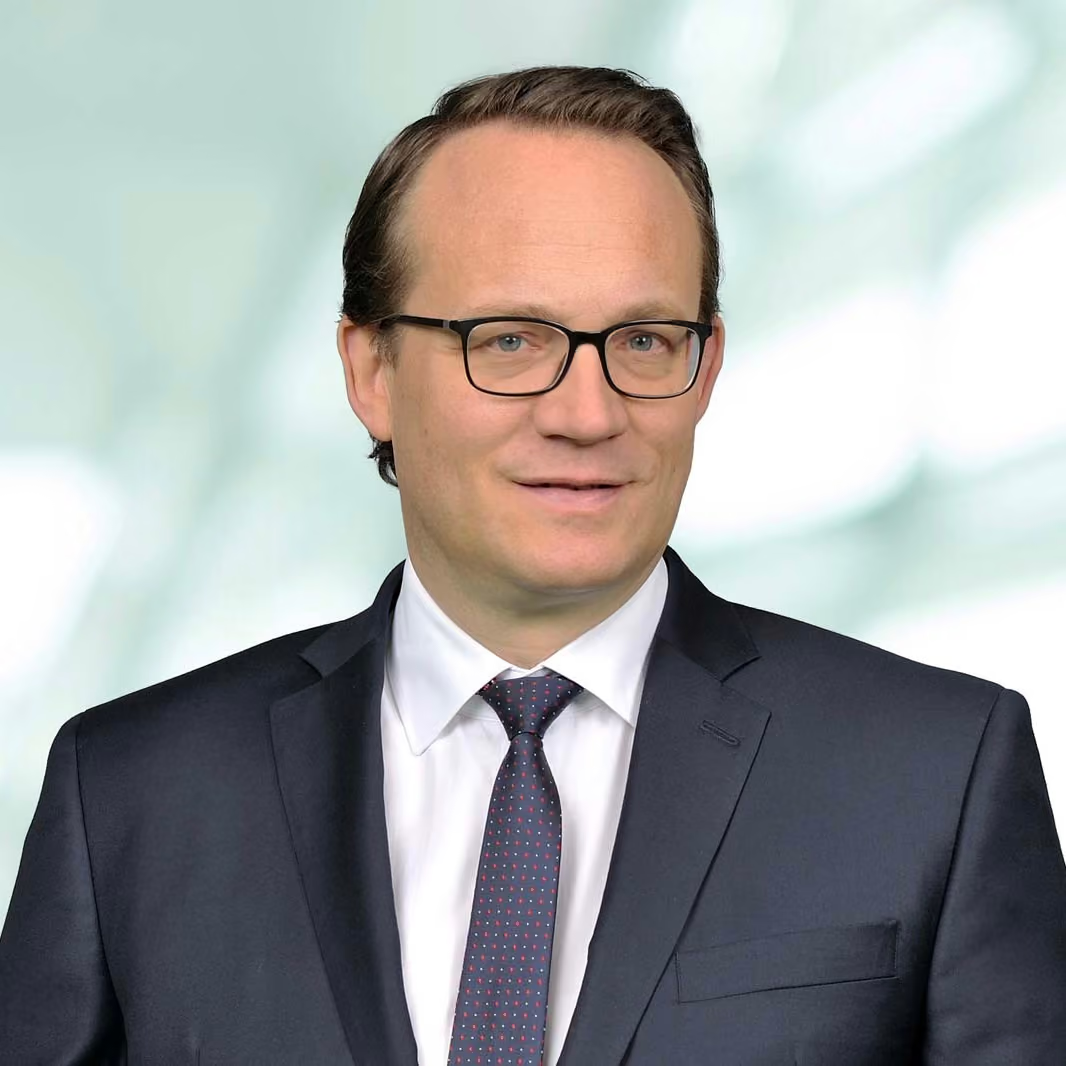
The past years have highlighted the critical interdependence between geopolitics and energy. Markus Krebber, Chief Executive Officer of RWE AG, shares why we need to rethink alliances for energy security.
Interviewed by Klara Marie Schroeder
Full energy autarky is not realistic for Europe. But the goal is a strategically diversified and resilient energy system, built on the rapid expansion of renewables and the electrification of large parts of our economy. The more electricity we generate from renewables – complemented by battery storage and flexible back-up capacities to bridge periods with little sun or wind – the smaller the residual demand that must be covered by imports of fossil fuels. In a world of growing geopolitical uncertainty, it is therefore vital to avoid over-reliance on any single energy source or a few supplier countries. Diversification across fuels, technologies, regions and partners is the core principle of energy security. In this context, it is an important step that Europe, and Germany in particular, has built additional infrastructure to import LNG by sea. This strengthens resilience by broadening our options. Looking ahead, further expanding and diversifying our portfolio of long-term supply contracts and building flexible, reliable international partnerships will be crucial to reducing critical dependencies while remaining firmly integrated into global energy markets.
We hedge geopolitical risk first and foremost through strict capital discipline and a diversified portfolio. We invest only where returns are robust and risks are manageable. That means we price risk appropriately, apply higher hurdle rates in a more volatile world and are very selective about where and how we invest. Diversification is another key lever. We balance our portfolio across regions and technologies and invest in flexible generation – including modern, hydrogen ready gas plants and battery storage – to support system stability in core markets like Germany and the US. In offshore wind, given the scale and long duration of projects, we systematically use partnerships and project level financing to share risks. If projects no longer meet our risk-return criteria or if the regulatory environment deteriorates, we are prepared to pause, reshape or exit them and reallocate capital.
Europe must not swap one dependency for another, but the answer is not economic nationalism. Open trade and diversified global supply chains are essential to keep the energy transition affordable and scalable, while systematically strengthening local and European value chains. Renewables are associated with specific supply-chain dependencies, for instance in solar PV, batteries and certain critical raw materials, where value creation is still heavily concentrated outside Europe. This underlines the need to diversify procurement, expand regional manufacturing capacity and deepen partnerships along the value chain. The key question is therefore: which dependencies are a normal part of global trade, and which pose unacceptable strategic risks? Only in the latter cases should Europe consider targeted interventions – and even then, preference schemes should remain a last resort. Resilience should primarily come from diversification, trade agreements, trusted partnerships, recycling, European manufacturing and joint ventures in key technologies such as batteries and grid infrastructure. This is the basic logic behind EU initiatives that link net‑zero investment with tronger local value creation. Overall, Europe should follow a “Made with Europe” approach: staying open, attracting investment and strengthening local supply chains. A more stringent “Made in Europe” approach should be reserved for clearly defined, critical technologies where we need to build or retain our own capabilities.
The biggest bottleneck today is clearly the underlying infrastructure, in electricity it is the grid. You can build renewables, electrify demand and even plan new backup capacity – but if the network to transport electricity is missing or delayed, the whole system slows down. That is exactly what we are seeing across Europe: projects are ready, but grid connection and expansion are not keeping pace. New generation, new industrial loads and data centres all depend on networks that are simply not being expanded fast enough.
Permitting and backup capacity are also critical. Without timely permits, we cannot invest; without sufficient battery storage and hydrogen-ready gas plants, we cannot guarantee security of supply, especially over longer periods of low wind and solar output. But the grid is the central enabler that links everything together and ensures electricity actually reaches customers. If Europe wants to accelerate the energy transition in a serious way, grid expansion and reinforcement must move from being seen as a purely technical issue to being treated as a strategic priority on a par with generation build-out.
Europe is setting very ambitious climate and energy resilience targets – and that is right. The main mismatch I see today is not so much in the level of ambition, but in the stability and practicality of the framework needed to deliver it. A good example is the European Emissions Trading System (ETS). It is a functioning, largely market-based instrument that sets effective incentives for decarbonisation and investment. Many companies in the energy, steel and building materials sectors have invested on the assumption that the ETS will remain a reliable long-term mechanism. Where political ambition and system reality diverge is when the ETS itself is repeatedly called into question. Fundamental debates about its future create uncertainty, put pressure on allowance prices and risk delaying the very investments Europe needs. Instead, we need a structured discussion about targeted adjustments – for example, a limited allocation of emission allowances beyond 2040 and a targeted extension of free allocations – so that climate ambition, industrial competitiveness and investment certainty are aligned rather than in conflict.
In energy, alliances are not a “nice to have”, they are a necessity. Recent years have shown how vulnerable critical dependencies can make us. To build a more resilient system, we need stronger, more reliable partnerships along the entire value chain – from policymakers and regulators to suppliers, project developers, grid operators and offtakers. This is not only about diversification, but also about coordination. The energy system is too complex for isolated decisions. We need continuous dialogue to strike the right balance between greater resilience on the one hand and costs and competitiveness for consumers and industry on the other. If we do that well, alliances become a real driver of progress: they enable clearer regulation, faster implementation and concrete joint initiatives across countries and technologies. In this sense, “advancing alliances” in the energy sector ultimately means turning cooperation into execution at system level.
Markus Krebber is the Chief Executive Officer of RWE AG. Prior to his current position, he held several positions within the company - including Member of the Executive Board and Chief Financial Officer. Before joining RWE, Markus Krebber held several senior management positions at Commerzbank and worked for McKinsey & Company. He studied economics and business administration at Gerhard Mercator University in Duisburg and Indiana University of Pennsylvania. In 2007 he received a doctorate from Humboldt University in Berlin.




 Share on X
 Share on LinkedIn