

Diana Mandewo, a BGD Young Voice 2026, makes the case for a new Africa–Europe health alliance built on shared knowledge and responsibility, exploring how cooperation in research and data, the health workforce, and climate resilience can strengthen health systems on both continents.
Diana Mandewo, a BGD Young Voice 2026, makes the case for a new Africa–Europe health alliance built on shared knowledge and responsibility, exploring how cooperation in research and data, the health workforce, and climate resilience can strengthen health systems on both continents.
Over the next decade, an AI system trained in Europe will guide diagnoses in African hospitals. Health professionals trained in Africa will care for an aging European population. Vaccines tested at African trial sites will influence European health policy, global supply chains and public purchasing on both continents. This future is already taking shape. Since 2022, more than €2 billion has been committed to Africa-Europe health priorities through initiatives linked to the Global Gateway partnership.
We are entering an uncertain future. AI is reshaping almost every aspect of human life. Healthcare has not been spared. At the same time, geopolitical alliances are being renegotiated at an unprecedented pace. We can hazard guesses, but the future remains largely uncertain. In this environment, Africa–Europe health cooperation cannot remain organized around a donor and a recipient. It must become an alliance of equals that is built on shared knowledge and responsibility. The health futures of both continents are interconnected and interdependent through the movement of people, pathogens, data, research and technology.
My essay proposes three areas for practical health cooperation between Africa and Europe across investment and policymaking.
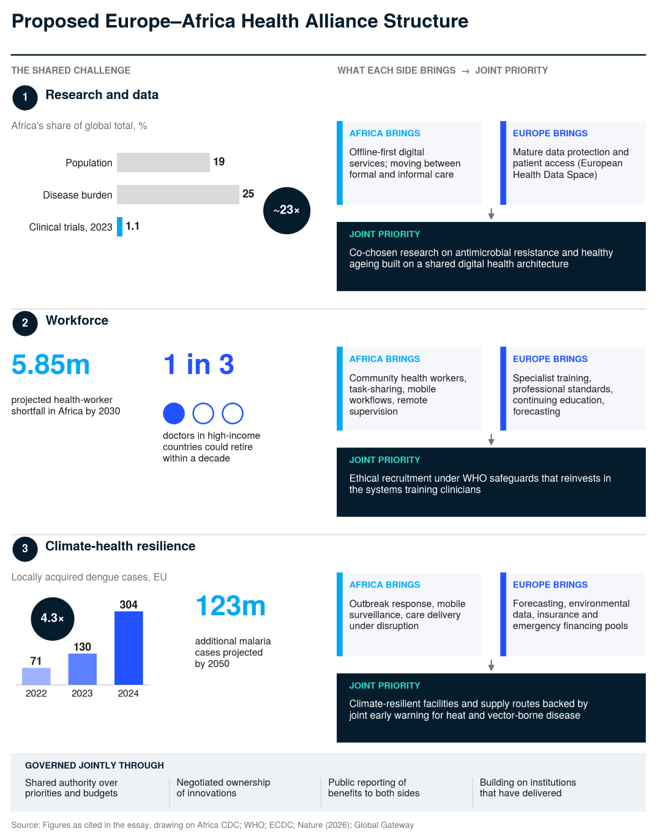
Africa has 19% of the world’s population and carries about 25% of its disease burden, yet it hosted only 1.1% of global clinical trials in 2023. The continent accounts for about 3% of global oncology trials, with just 62 active oncology trial sites across 21 sub-Saharan African countries. These numbers describe a research deficit that has knock-on effects on evidence-based care. A partnership in health innovation research would help strengthen African clinical research and move beyond a model primarily dependent on aid. The Africa CDC reported that official development assistance for health fell by roughly 70% between 2021 and 2025. The old model, in which grants indefinitely sustain African research, is becoming less plausible.
The uncertainty in the funding landscape provides an opportune moment to introduce a new model of partnership between Europe and Africa. The goal would be to choose problems that matter on both continents. Antimicrobial resistance, climate-sensitive disease, and healthy ageing are obvious candidates.
Internet use in Africa rose from 25% in 2019 to 38% in 2024. About 38–40% of Africans are online, compared with more than 90% of Europeans. This creates a significant constraint on the uptake of digital health innovations in African hospitals. Europe is trying to solve a different digital problem through the European Health Data Space, adopted in 2025. The EU and WHO have also committed €8 million for digital health cooperation from 2025 to 2028, working with Africa CDC and the Global Digital Health Certification Network.
In digital health, Africa is constrained by scarcity, whereas Europe is constrained by accumulated complexity. The partnership should leverage that asymmetry. African systems have developed offline-first services and ways of moving between formal and informal care. Europe has built mature approaches to data protection and patient access. A shared architecture should combine those strengths.
Africa is projected to face a shortage of 5.85 million health workers by 2030. Europe is entering its own workforce squeeze. In 2026, the WHO warned that one in three doctors in high-income countries could retire within the next decade. Ageing populations will increase demand at the same moment that experienced staff leave the system. The temptation is to treat these shortages as complementary. Europe needs health workers and Africa has a young population. Supply appears to match demand. But the arithmetic is not one-to-one. One employer fills a vacancy, while the source country loses the public investment used to train that professional.
The WHO’s safeguards list exists because individual freedom to move and national workforce policy are different questions. A clinician should be able to pursue a career abroad. A receiving country should account for the capacity it draws from poorer health systems with weaker universal health coverage. Europe faces retirement and an uneven distribution of staff. International recruitment will remain part of the response. It cannot carry the entire response without reproducing the same shortages elsewhere.
I propose the introduction of a shared workforce strategy between Europe and Africa. Under a jointly governed agreement, European health systems that recruit clinicians from African countries would co-fund the training of replacement staff in those countries, so each vacancy filled in Europe strengthens African systems. Recruitment from countries on the WHO safeguards list would be managed through government-to-government partnerships. Mobility would also be designed through fixed-term placements, joint specialist fellowships and mutually recognized qualifications that allow clinicians to return home with a clear career path. There is useful learning in both directions. African health systems have extensive experience with community health workers, task-sharing, mobile workflows and remote supervision. European systems have deeper specialist training structures, professional standards, continuing education and workforce forecasting.
The WHO estimates that climate change could cause 250,000 additional deaths each year between 2030 and 2050, with direct health costs of $2–4 billion a year by 2030. A 2026 Nature model projected 123 million additional malaria cases and 532,000 deaths between 2024 and 2050. It attributed 79% of the additional cases and 93% of the deaths to health-service disruption caused by extreme weather, including areas across Africa.
Europe has not been spared. One analysis estimated 44,645 heat-related deaths in Europe in 2023, compared with about 20,400 road deaths. Greece recorded 6.5 times as many heat deaths as road deaths, and annual heat mortality could reach 120,000–129,000 by 2050. Vector-borne diseases are increasing as well. Locally acquired dengue cases in the EU rose from 71 in 2022 to 130 in 2023 and 304 in 2024.
These risks will not land on equal systems. Many African facilities have limited fiscal buffers, fragile supply routes and infrastructure that can lose power or access during floods, heatwaves and storms. European systems have stronger infrastructure, but they are confronting heat, dengue and other threats outside their historical planning assumptions. Here too, the learning is reciprocal. African institutions bring operational experience with outbreak response, mobile surveillance and service delivery under disruption. European institutions bring forecasting capacity, environmental data, insurance mechanisms and larger emergency financing pools.
Across all three areas, I would organize the framework around jointly governed agreements for shared health priorities. I have developed the chart below to illustrate this model:
European and African health systems already have partnerships worth building on. EDCTP2 reports supporting 154 clinical trials and helping seven interventions reach licensing or recommendation. AfricaConnect3, co-funded by the EU, reports improved connectivity benefiting over 3,000 institutions and nine million users. Those achievements sit within a relationship shaped by historic extraction and hierarchical partnerships. Healthcare presents a new frontier for creating an alliance of equals between Europe and Africa.
Practically, the next alliance should build on the institutions that have delivered, with shared authority over priorities and budgets, negotiated ownership of innovations, and public reporting of benefits to both sides. Workforce agreements should strengthen the systems that train clinicians. These would be practical demonstrations of equality.
Healthcare can lead the charge toward a real and realized alliance between Europe and Africa. Our connected histories place a responsibility on us to build that relationship honestly. Our connected health futures give us every reason to make it work.
A Tale of Two Health Futures would be, to quote, Charles Dickens’s A Tale of Two Cities, “A far, far better thing that I do.”




 Share on X
 Share on LinkedIn